
A pipe fails. Maybe there is water on the floor, a stain spreading across the ceiling, or a plumber has finally traced the pressure drop you have lived with for months. Now you face the question every homeowner hits eventually: do you patch this one spot, or replace the whole system?
A spot repair is cheaper today. That is obvious. What is less obvious is when “cheaper today” quietly becomes more expensive over three to five years. This guide gives you the decision framework, the cost math most articles skip, and the warning signs that mean patching has stopped making sense.
The Short Answer
Repair an isolated failure on a pipe system that is otherwise sound. Repipe when the failures are repeating, the pipe material is at the end of its life, or a plumber finds corrosion in multiple places. The deciding factor is not the single leak in front of you. It is the condition of the whole system behind it.
What Each Option Actually Means
Spot repair
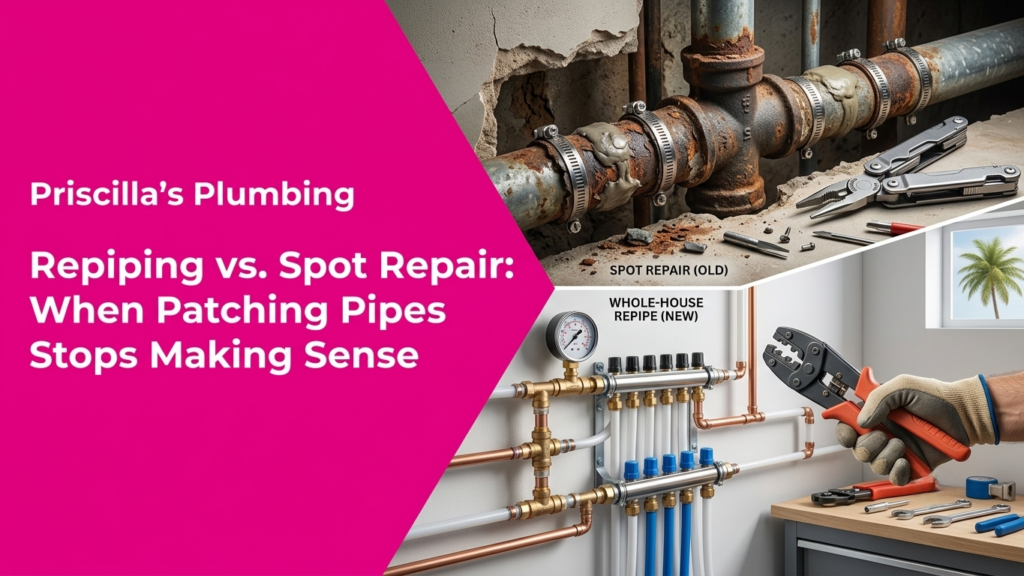
A spot repair fixes one isolated problem, a single leak, a cracked section, a failed coupling. The plumber opens the affected area, replaces or patches that length of pipe, and closes it back up.
- Pros: Fast, low upfront cost, minimal disruption, only the problem area is touched.
- Cons: Does nothing for the rest of the system. If the pipe failed because it is old and corroded, the next leak is already forming somewhere else.
Whole-house repipe
A repipe replaces all or most of the water supply lines in the home with new material, usually PEX in Florida. Instead of chasing failures one at a time, the entire aging system is upgraded at once.
- Pros: Eliminates the root cause, restores water pressure and quality, lowers future repair costs, adds resale value, and removes the risk of a surprise burst pipe.
- Cons: Higher upfront cost, takes a few days, requires cutting and patching drywall.
The Cost Math Nobody Shows You
This is where the real decision lives, and where most guides stop short.
A single spot repair looks cheap next to a full repipe. But an aging home with systemic corrosion rarely has just one leak. It commonly develops two to four leak repairs within a three-to-five-year window. Each one carries a service call fee, labor, and materials. Stack them up, and the total often approaches or passes what one repipe would have cost.
Then add the costs that do not appear on the repair invoice:
- Water damage remediation. If even one leak soaks drywall, flooring, or cabinetry, the cleanup alone can exceed the price of a full repipe.
- The repeated disruption. Every repair means another hole in the wall, another day waiting on a plumber, another patch job.
- The leaks you do not catch in time. A hidden leak behind a wall or under the slab can run for weeks before you notice, multiplying the damage.
When you view the choice over five years instead of one afternoon, the repipe is frequently the cheaper path, not the more expensive one. Homeowners who have ridden out the recurring-leak cycle almost always say the same thing in hindsight: they wish they had repiped sooner.
When a Spot Repair Is the Right Call
Repair makes sense when the problem is genuinely isolated. Choose a spot repair when:
- The leak is in one accessible location
- The rest of the plumbing tested in good condition
- The pipe material still has years of service life left
- This is the first failure you have had, not the third
- The damage was caused by an outside event (a nail through a pipe, an accident) rather than age or corrosion
If a plumber inspects the system and finds the surrounding pipe healthy, there is no reason to replace what is working.
When Patching Stops Making Sense
These are the signals that you are past the point of repair and into repipe territory.
You are paying for repeated leaks
The clearest sign. More than one leak in the same pipe run, or three or more leaks in a short span, means the pipe is failing systemically, not by accident.
Your pipes are old, and the material is the problem
Age is the leading indicator. Homes built before the 1970s often carry galvanized steel or cast iron that is now well past its rated lifespan. Re-plumbed homes from the late 1970s through the 1990s may have polybutylene, which fails from the inside out. When the material itself is the issue, every repair is just buying time.
A plumber finds corrosion in multiple places
If an inspection turns up corrosion, scaling, or thinning at several points, that is a whole-system condition, not a localized one. Patching one spot leaves the others to fail on schedule.
Discolored water or falling pressure across the whole house
Rusty, brown, or metallic water and a gradual pressure drop throughout the home point to pipes corroding from the inside everywhere, not a single bad section.
Your water bill keeps climbing
Rising bills with no change in usage signal leaks, sometimes several at once, including hidden ones.
The South Florida Factor
Local conditions push homes toward the repipe side of the line faster than in much of the country. The humidity, salt air, hard water, and acidic soil around Oakland Park, Fort Lauderdale, and the surrounding Broward area accelerate corrosion on metal pipes. A galvanized or cast-iron system that might have limped along elsewhere tends to fail across the board here, which means spot repairs on these older local homes are more often a losing game.
There is also an insurance and resale dimension worth knowing. Repeated leak claims create a documented history that can complicate insurance renewals and home sales, and Florida carriers have grown strict about old pipe materials. In some cases, a repipe is what keeps a home insurable, which changes the math beyond simple repair costs.
How to Decide With Confidence
You do not have to guess. The right move is a professional assessment of the whole system, not just the leak in front of you.
- Get the system inspected, not just the leak. A plumber can check pipe material, age, and corrosion across the home.
- Ask for the honest condition of the rest of the pipes. One leak on a healthy pipe is a repair. One leak on a failing system is a warning.
- Run the five-year math. Compare the likely cost of repeated repairs plus potential water damage against a one-time repipe.
- Factor in your timeline. Planning to stay in the home for years tilts toward repiping; the payback period is real.
Priscilla’s Plumbing inspects the full system, gives you a straight read on whether you are looking at a repair or a repipe, and serves homeowners across South Florida 24/7.
FAQ
When should I repipe instead of repairing a leak? When leaks repeat, the pipe material is at the end of its life, or corrosion appears in multiple places.
Is a spot repair ever the better choice?
Yes, for a first-time, isolated leak on a pipe that is otherwise in good condition.
How many leaks mean I need a repipe?
Generally, three or more leaks in a short span, or repeated leaks in the same run.
Does repiping save money over repeated repairs?
Often yes. Over a three-to-five-year window, repeated repairs plus water damage can exceed a repipe.
How old do pipes have to be before repiping?
Homes built before the 1970s, or with polybutylene from the 80s to 90s, are strong repipe candidates.
Will repeated leak repairs affect my insurance?
They can. A documented leak history may complicate renewals, and old pipe materials are increasingly flagged.