
Finding a leak under your house is scary. If your home sits on a thick concrete floor called a slab foundation, broken pipes can feel like a nightmare. You might worry about workers breaking your floors, making a giant mess, or costing you a fortune.
When you need to fix these underground sewer lines, you usually have to choose between two main paths. It is trenchless pipe replacement vs traditional digging. Both methods are completely different but offer the same result: seamless sewer lines without any leakage.
But which one is better? Let us break it down and help you see which fix fits your home, your family schedule, and your budget perfectly.
What Is the Traditional Way of Trench Excavation?
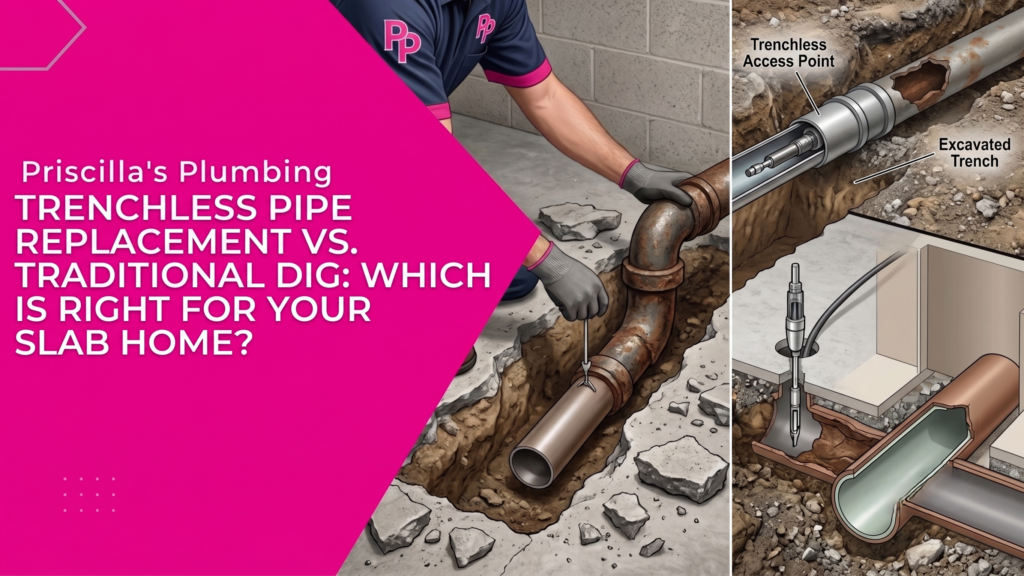
For a long time, open trench excavation was the only classic method. A plumber locates the damaged pipe, then digs a trench through the yard, driveway, or slab to reach it. The old pipe is removed, a new one is put in its place, and the trench or slab is filled back in.
This method works, and it has been used for decades. After they change the old pipe for a new one, they have to put the dirt back. Then comes the concrete method, which means pouring new concrete to patch up the big hole in your floor.
The Good Things:
- It works even if your underground pipe is completely crushed flat or has slid out of its straight line.
- Plumbers can see the whole pipe with their own eyes.
The Bad Things:
- It creates a massive amount of dust, loud noise, and dirt inside your home.
- You may have to move into a hotel for a week or more while they work.
- The concrete slab restoration leaves you with broken floors that you have to pay to replace.
What Is Trenchless Pipe Repair?
Modern technology gives us a much cleaner choice. It is called trenchless repair, or “no-dig” technology. Instead of making a long trench through your home, plumbers make just one or two small access holes outside your house. Trenchless methods fix or replace the pipe from the inside, using small access points instead of long trenches.
There are two smart ways plumbers do this without destroying your floors.
1. CIPP Method
With CIPP cured-in-place lining, plumbers do not remove your old pipe. Instead, they slide a flexible, fabric tube coated with special wet glue (called resin) inside your old, cracked pipe. They inflate the tube like a long balloon.
Once the glue dries and hardens, the tube becomes a brand-new, smooth, rock-solid pipe right inside the old one. It seals up every single crack and stops tree roots from getting inside.
2. Pipeline Bursting Method
Another method that is a great fit when the old pipe is badly damaged, cracked, or too small for today’s water flow needs is the pipe bursting method. They pull a heavy, cone-shaped bursting tool right through your old pipe.
As the tool moves, it breaks the old pipe apart and pushes the pieces into the surrounding dirt. At the exact same time, it pulls a brand-new, seamless plastic pipe into place behind it.
Looking at the Real Costs of Trenchless Pipe Replacement VS Traditional
When you get a price quote from a local plumbing team, you have to look at the big picture.
A traditional dig might look cheaper at first glance if you only look at the plumbing work. But you must think about the no-dig repair cost versus the “hidden” costs of open trench digging.
Let us look at how the total costs match up for a slab home:
| Part of the Job | Traditional Open Trench Dig | Trenchless Repair |
| Digging the Hole | High (takes lots of workers and hours) | Low (only needs small entry points) |
| Fixing the Pipe | Moderate cost for parts | Higher cost for advanced machinery |
| Floor Restoring | Very high (new concrete + new flooring) | Zero cost (your floors never get touched) |
| Hotel & Eating Out | High (if you cannot stay in your home) | Zero cost (done in 1 to 2 days) |
Trenchless fixes save you money because you do not have to rebuild your home from scratch after the plumbers leave.
How to Choose the Right Method for Your House
Every slab home is unique, and local soil conditions matter a lot. Here is a simple checklist to help you figure out which option works best for your situation.
Choose Trenchless If:
- Your indoor floors are brand new, expensive, or hard to replace.
- The bad pipe is underneath your kitchen cabinets, bathroom tile, or a main hallway.
- You want the plumbing work done fast so your life can get back to normal within 24 to 48 hours.
- Your old pipe still holds its basic round shape and is not fully collapsed.
Choose Traditional Digging If:
- Your underground pipe has completely caved in, meaning tools cannot slide through it.
- The pipe has sagged deeply down into the dirt, creating a big “belly” where waste gets stuck.
- Your home foundation has shifted so much that the pipes are completely disconnected.
Let Our Trusted Local Experts Help You Today
Dealing with a slab leak can feel overwhelming. But comparing trenchless pipe replacement vs traditional digging and making the right decision is even more confusing. We have tried to answer all your questions in this guide so you can make an informed decision.
One team that can take all your worries away is Prisicall’s Plumbing. Our friendly, licensed plumbing team starts by sliding a special waterproof camera down into your sewer line. This lets us see the exact problem on a video screen, so we can show you exactly what is wrong before we start.
We offer you the best decision for pipe replacement so it can offer the precise results as well as not emptying your pockets. Call Prisicall’s Plumbing now or contact us online for the latest plumbing solutions, honest upfront pricing, and clear answers.
FAQ
What is trenchless pipe repair?
It is a way to fix or replace pipes using small access points instead of digging a long trench, through methods like pipe bursting or CIPP lining.
Is trenchless pipe repair good for slab homes?
Yes. Since it needs little to no digging, it avoids breaking up the concrete slab in most cases, which makes it a strong fit for slab homes.
What is the difference between pipe bursting and CIPP lining?
Pipe bursting breaks the old pipe and pulls a new one into its place. CIPP lining inserts a liner that hardens into a new pipe inside the old one.
Does trenchless repair cost more than digging?
Not usually. Once slab repair, landscaping, and extra labor days are added to open trench pricing, trenchless is often the same price or less.
How do I know which method my home needs?
A camera inspection of the pipe shows its exact condition, which tells a plumber whether trenchless repair will work or if open trench digging is needed.