

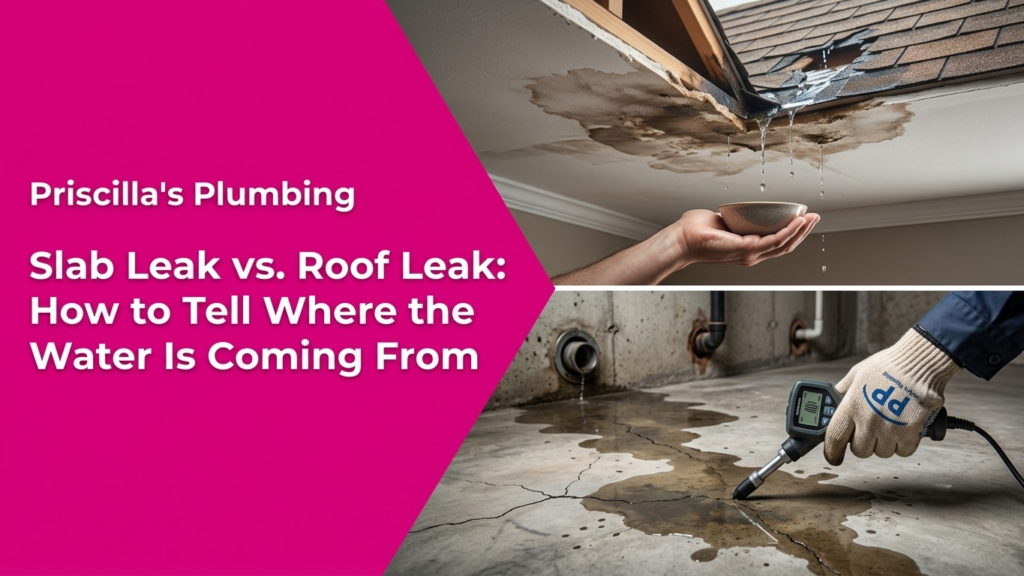
You look up. There’s a wet spot on your ceiling. Or maybe you look down, and your baseboard feels damp under your foot. Either way, your gut says the same thing: something’s wrong, and I don’t know what. Whether it’s a water stains ceiling not roof leak, or vice versa. But how to know it exactly.
Here’s the good news. You don’t need to be a plumber to make a smart first guess. Water almost always tells you where it came from; you just need to know what to look for. Let’s walk through it together, so you can figure out if you’re dealing with a roof leak or a slab leak before you even pick up the phone.
The One Rule That Explains Almost Everything
If you are facing a leak or damp spots, here is a simple rule to follow. Water follows gravity. That’s it. That’s the whole trick.
- A roof leak starts high, up top, and travels down. That’s why you see ceiling water stains, drips from light fixtures, or wet spots in the attic.
- A slab leak starts low, under the concrete floor of your house, where water and sewer pipes run. The water has nowhere to go but up, into your flooring, your baseboards, and sometimes your walls near the floor.
So the very first question to ask yourself is simple: did the wet spot start near the ceiling, or near the floor? That one answer already points you in the right direction.
Signs You’re Looking at a Roof Leak
A roof leak happens when rain gets through broken shingles, cracked flashing, or blocked roof gutters. Water creeps into your attic and drops onto your ceiling. Watch out for these signs before calling professional leak detection services in South Florida.
- Water stains on the ceiling often look like yellow, brown, or tan rings, kind of like a coffee stain that keeps spreading.
- Drips or puddles coming from a light fixture, vent, or ceiling corner.
- A damp, musty attic. Wet insulation or drops of water on the wood beams above your ceiling are a big clue.
- Damage or Missing shingles, cracked flashing around a chimney, or gutters stuffed with leaves can all send water where it shouldn’t go.
Signs You’re Looking at a Slab Leak
Many South Florida homes sit on concrete slabs. Underneath that thick concrete are clean water pipes and drain lines. When an old pipe cracks, you may run plumbing leak detection right under your feet.
Moreover, slab leaks are sneakier. There’s no storm to blame; the pipe just cracks quietly under your floor. These signs creep up slowly.
- A warm spot on the floor. If it’s your hot water line leaking, the tile or wood above it can feel oddly warm, like the floor has its own little heater.
- Your water bill jumps for no reason, even though nothing in your daily routine changed.
- Floors start to shift. Hardwood that cups or buckles, tile that cracks or pops loose, or linoleum that bubbles up.
- Water pressure drops around the house.
- A musty smell near the floor, or a damp baseboard that never seems to fully dry, is one of the clearest damp baseboard vs ceiling stain clues. If the wet spot is low and creeping up the wall instead of coming down from the ceiling, think slab, not roof.
Roof Leak vs. Slab Leak at a Glance
The table below shows how roof leaks and slab leaks work in homes in South Florida. Take a look and find out the exact reason you are facing wet spots in your house.
| Feature | Roof Leak | Slab Leak |
| Where it Starts | Up high (roof, attic, rain) | Down low (under concrete slab) |
| Main Symptoms | Ceiling stains, wet attic, roof drips | Wet carpet, hot floor spots, damp baseboards |
| Water Meter Test | Meter stays still | Meter spins continuously |
| Triggers | Heavy rain, old shingles, clogged gutters | Aging cast iron pipes, ground shifting, pipe wear |
Wait — Water Stains on Ceiling Not From a Roof Leak!
Here’s something a lot of homeowners miss: not every wet ceiling means a roof leak, and not every damp floor means a broken pipe. One sneaky culprit in Florida homes is the AC condensate drain line as well. When this small drain line clogs, it backs up and drips water right through your ceiling, so you get a water-stain ceiling, not a roof leak situation, even though your roof is perfectly fine.
That’s why real moisture source inspection matters. Before anyone tears into your ceiling or your floor, the goal should be to pin down the exact intrusion location: roof, slab, AC line, or even a leaky appliance nearby. Guessing wrong means paying for the wrong fix.
The 5-Minute Water Meter Test
Still not sure where the water intrusion location is in your house? You can run a simple 2-minute test using your outdoor water meter. Try this:
- Find your main water meter, usually near the street or by your front yard.
- Make sure nothing in the house is using water: no washing machine, no dishwasher, no running toilet.
- Watch the little dial or leak indicator on the meter.
If you are still unable to do an exact moisture source diagnosis, water is moving somewhere in your plumbing, which points toward a slab leak. If the dial sits perfectly still, your plumbing is probably fine, and the damage is more likely coming from your roof, your AC line, or somewhere else.
When in Doubt, Let Someone Who Knows Take a Look
Dealing with hidden water damage can feel overwhelming, but you don’t have to figure it out alone. You cannot determine by a look that these are water stains on the ceiling, not a roof leak or the other side. Here you need a reliable partner who understands the problem immediately and promises you adequate solutions.
Whether that mystery stain turns out to be a slab leak, a roof issue, or a clogged AC line, Priscilla’s Plumbing team carries the tools to trace it back to the real source before anyone touches a wall or a floor. Same-day visits, honest answers, and a free quote before any work begins- that’s just how we do things.
Curious what’s really going on under your feet or over your head? Give Priscilla’s Plumbing a call, and let’s get you an answer today instead of another night of wondering.
People Also Ask
Can a ceiling stain be something other than a roof leak?
Yes. A clogged AC condensate line is one of the most common non-roof reasons for water stains on the ceiling, especially in humid climates like South Florida.
Is a slab leak an emergency?
It can turn into one fast. Left alone, it can undermine flooring and even your foundation, so it’s worth getting checked quickly rather than waiting.
Can I fix a slab leak myself?
Finding the exact spot under a concrete slab takes real leak-detection equipment. This isn’t a DIY job; a wrong guess means unnecessary demolition.